Johannes Andersen
Danish furniture designer Johannes Andersen worked for many manufacturers in the 1950s and 1960s, from small Jutland workshops to Swedish producers, mostly in teak and rosewood.
Background
Johannes Andersen is a very common Danish name, and his biography is poorly documented. Auction houses, including Bruun Rasmussen in Copenhagen, give his dates as 1903 to 1991. The most detailed account is Leif Olsson's book on the Swedish manufacturer Trensum, published with Blekinge Museum: according to the author, Andersen was born in Aarhus in 1903, qualified as a cabinetmaker in 1922, worked in 1930 as a furniture draughtsman for an architecture firm in Aarhus, then opened his own architecture and furniture workshop in the 1930s, and became established as a furniture architect after the Second World War. He died at the age of 88 in Hillerød, on Zealand. The book itself notes that his birth in Aarhus in 1903 has not been confirmed by verifying sources. The furniture index of Designmuseum Danmark lists dozens of his designs for manufacturers such as George Petersen, Hovedstadens Møbelfabrik, C.F. Christensen and Uldum, from the mid-1950s onward.
Johannes Andersen and Trensum
Trensums Fåtöljfabrik was founded in Karlshamn, in southern Sweden, at the end of the Second World War by three young upholsterers, Folke Olsson, Tage Persson and Henry Johansson. The factory first made simple, affordable armchairs. Its owners met Johannes Andersen in 1957, and the first models from the collaboration were shown at the Gothenburg furniture fair in 1958. The partnership changed the firm's range, with sofa groups named Hollywood, Capri, Florida, London, Milano, Bermuda, Riviera or Oxford, names that still turn up at design auctions today. In the 1960s Trensum also had a subsidiary in Chicago, Trensum Incorporated, which explains why some of these models are found in the United States.
The Capri sofa and armchair, presented at the 1965 furniture fair, are the best-known result: a rounded shell on a swivel base, with a backrest shaped like a disc. The F 106 coffee table was launched alongside the Capri group, with the curved, smile-shaped drawer openings that are typical of Andersen, a detail also found on the Smile table for C.F. Christensen. The Excellent armchair, with its sculpted wooden base, is probably the model on which the woodwork was taken furthest.
Manufacturers and designs
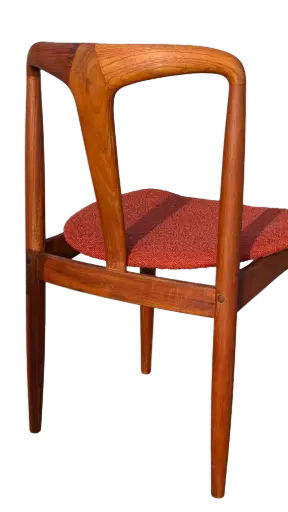
- Uldum Møbelfabrik (Jutland): Juliane dining chair, 1960s, and other chairs and sideboards.
- C.F. Christensen, Silkeborg (CFC Silkeborg): model 206 coffee table, nicknamed Smile, around 1957.
- Trensums Fåtöljfabrik, Karlshamn (Sweden): Capri sofa and armchairs, 1965, F 106 coffee table and Excellent armchair.
- Other manufacturers cited by dealers and in Leif Olsson's book include J. Skaaning and Søn, Christian Linneberg, Bernhard Pedersen and Søn, Møbelfabriken Falster, Hans Bech, Sidelmann Jakobsen and R. Skovgaard Jensen in Viborg.
Johannes Andersen pieces at Fynd Vintage
Looking for a specific piece? Our sourcing service can search for it. Contact us
Sources
- Mr Bigglesworthy: Johannes Andersen
- Pamono: Johannes Andersen
- Design Addict: Johannes Andersen
- Galerie Møbler: Uldum Møbelfabrik
- Bruun Rasmussen: Johannes Andersen lot (2026)
- Designmuseum Danmark: furniture index
- Leif Olsson, Trensums Fåtöljfabrik och den danske möbelarkitekten Johannes Andersen, Blekinge Museum